

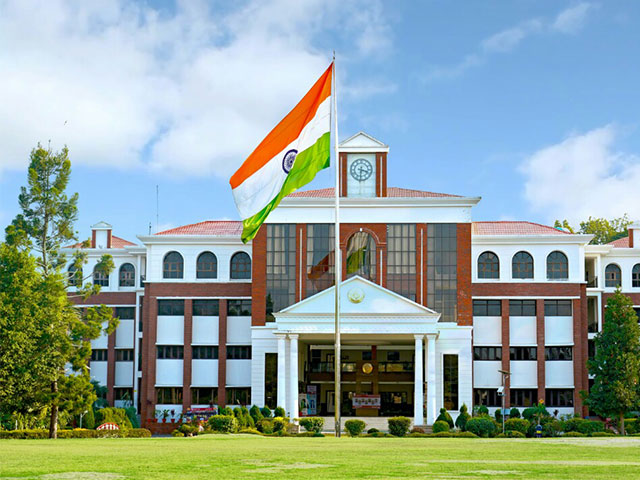
Graphic Era (Deemed to be University)
His vision gained concrete shape in 1996 in the form of the Graphic Era Institute of Technology (GEIT). In 2008, it was accorded the status of Deemed University under Section 3 of the UGCAct, 1956 vide Notification F.9-48/2007-U.3 (A) dated 14 August 2008 and approved by the Ministry of Human Resource Development, Government of India.
Today, Graphic Era (Deemed to be University) stands tall as NAAC ‘A+’ accredited university with 7 NBA accredited programs and is ranked among the Top 50 Universities of India by National Institutional Ranking Framework (NIRF), Ministry of Education with All India Rank 52 in the Engineering Category, All India Rank 52 in Management Category, and All India Rank 48 in the University Category by NIRF 2025.
The premier university regards industry-academia partnership as an integral part of teaching methodology & curriculum and has taken big initiative in engineering programs by getting into partnerships with Tata Technologies and IBM. Moreover, it hosts Technology Business Incubator that funds, mentors and nurtures ideas, start-ups and technology-based entrepreneurship.
Graphic Era (Deemed to be University) has acquired transnational dimensions through student exchange and knowledge-sharing programs with many foreign universities and has been acclaimed and honored at international forums for its brilliance in upholding the highest standards of education. The alumni of Graphic Era are making their mark worldwide in marquee brands like Apple, Google, Microsoft, HSBC, to name a few and in the service of the nation in all wings of the Armed forces
ICGRSE 2026
The International Conference on “GST Reforms and Their Socio-Economic Impact: Building Inclusive Economic Growth and Digital Excellence” aims to critically examine the next-generation GST reforms announced on 15 August 2025 and implemented from 22 September 2025, and their multi-dimensional implications for India’s economy and society. Organized by the Department of Management Studies, Graphic Era (Deemed to be University), Dehradun, this two-day hybrid conference (13–14 March 2026) seeks to bring together academics, policymakers, industry experts, and practitioners to deliberate on structural changes in India’s indirect tax regime and their consequences for growth, inclusion, and governance.
We have also planned a Pre-Conference Workshop on “GST Analytics, Tariff Systems & Digital Tax Administration: Tools, Techniques and Global Best Practices” on March 12, 2026, organized by the Department of Management Studies, Graphic Era (Deemed to be University), Dehradun.
The conference is thematically aligned with ICSSR’s concept note and will address key domains such as the evolution of India’s tax structure and fiscal federalism, changes in consumption patterns, the impact of GST reforms on MSMEs, start-ups and entrepreneurship, rural and urban livelihoods, sectoral competitiveness, regional and state-level revenue dynamics, legal and judicial perspectives, and the role of digitalisation, data analytics, and emerging technologies in strengthening GST compliance and administration. Special focus will be placed on vulnerable groups, regional disparities, household welfare, and welfare-state commitments, thereby linking GST reforms to the broader agenda of Atmanirbhar Bharat, Viksit Bharat 2047, Digital India, Make in India, and inclusive growth.
The conference structure combines keynote addresses, parallel technical sessions, expert panels, public dialogue, and industry–academia interaction to generate rigorous empirical and conceptual insights on GST reforms. It is expected to yield 80–100 research papers, 15–20 policy briefs, thematic discussion papers, and peer-reviewed publications that will inform policymakers, tax administrators, and other stakeholders on implementation challenges, best practices, and design refinements in the evolving GST framework. The event will thus serve as a high-impact platform for advancing social science research, strengthening evidence-based policymaking, and enhancing research capacity on taxation and public finance in India.
School of Management (GESoM)
Graphic Era School of Management (GESoM), Graphic Era (Deemed to be University), Dehradun, is a premier institution dedicated to excellence in management education, research, and industry engagement. GESoM offers undergraduate, postgraduate, and doctoral programs that integrate rigorous academic foundations with experiential learning, industry exposure, and global perspectives.
The School emphasizes interdisciplinary research, innovation, and ethical leadership, with strong focus areas including finance, marketing, human resources, operations, business analytics, fintech, sustainability, and digital transformation. Through a blend of case-based pedagogy, live projects, internships, global immersion programs, and collaboration with reputed institutions and industry partners, GESoM nurtures future-ready professionals and scholars.
With a distinguished faculty, robust research output, modern infrastructure, and vibrant academic culture, GESoM provides an ideal platform for scholarly dialogue and knowledge exchange, aligning seamlessly with national and international conferences that address contemporary business, policy, and societal challenges.
Primary Objectives
The International Conference on GST Reforms and Their Socio-Economic Impact seeks to achieve the following objectives:
- Encourage rigorous academic research and policy analysis on next-generation GST reforms and their multi-dimensional impact on India’s economy and society
- Foster meaningful academic deliberations among scholars, researchers, policymakers, and industry professionals on structural changes in the tax regime
- Build awareness among stakeholders about the transformative potential and implications of GST reforms for different sectors and population groups
- Provide platforms for informed dialogue and evidence-based policy discussions on effective implementation and further refinements of GST reforms
- Support the national mission of Atmanirbhar Bharat and Viksit Bharat 2047 by examining how GST reforms strengthen India’s self-reliant economic architecture
- Disseminate research findings and policy briefs on GST reforms to wider audiences, including academicians, policymakers, and practitioners
- Facilitate inter-disciplinary and multi-sectoral perspectives on GST reforms’ impact on vulnerable populations, regional economies, and social welfare
Expected Outcomes and Impact
The conference will produce tangible outcomes that contribute to the social science knowledge base and policy discourse:
- Research Presentations and Papers: Approximately 80-100 research papers and presentations from national and international scholars
- Policy Briefs: 15-20 evidence-based policy briefs synthesizing key findings on sectoral impacts and implementation challenges
- Discussion Papers: Proceedings and discussion papers on critical themes for publication and wider dissemination
- Stakeholder Engagement: Direct participation from policymakers, central and state tax officials, industry representatives, and civil society organizations
- Capacity Building: Enhanced research capacity and awareness among researchers, academics, and practitioners on GST reforms
Abstract Submission Deadline
Call for full Paper Submission
Full Paper Submission Deadline
Acceptance Intimation
Registration Last Date